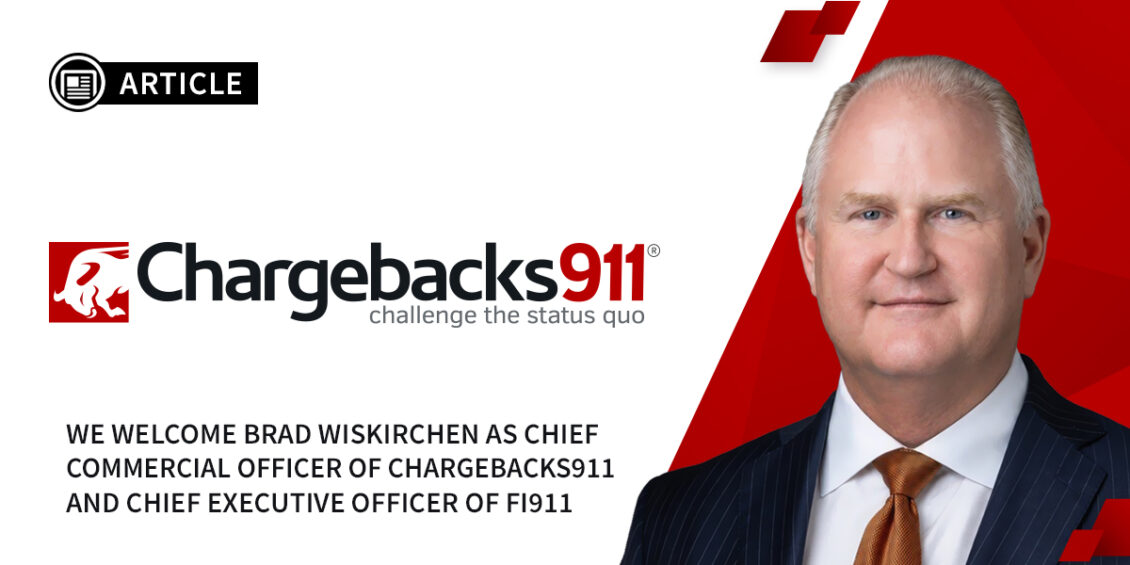
I’m excited to announce that Brad Wiskirchen, Founding CEO of Kount, is now onboard to be Chief Commercial Officer of Chargebacks911 and Chief Executive Officer of Fi911!
Brad really needs no introduction for anyone who has watched the fraud and identity space evolve over the last two decades. He helped build Kount from a startup into a globally recognized fraud prevention platform before it was acquired by Equifax, where he went on to serve as General Manager of Equifax Digital Solutions. He served as an industrial partner at CVC Capital Partners, leading fintech investment in North America. He chaired the Salt Lake City Branch of the Federal Reserve Bank of San Francisco. And, he served on the IMF’s High-Level Advisory Group on Finance and Technology.
That’s an impressive resume. More than that, though, it’s a map of the payments ecosystem’s most important intersections. And, it’ll make Brad an invaluable player in what comes next for our company.
The Next Chapter for the Payments Ecosystem
The payments industry has a problem with self-containment. Companies build their competencies in a lane, they deepen that lane, and then they optimize within it. That’s not a criticism; it’s rational. But, it means that genuine scale requires something more than execution. It requires the ability to see beyond the lane.
That’s part of what Brad will bring to us. His appointment is about more than expanding our leadership team. It’s about accelerating what’s next.
We’ve spent years building the technology, infrastructure and industry relationships that have positioned Chargebacks911 at the center of an increasingly important part of the payments ecosystem. The opportunities ahead extend well beyond traditional dispute management, and we’re bringing together the talent, capabilities and strategic relationships to pursue them at scale.
What does that look like in practice?
Well, Chargebacks911 was built to solve a specific problem: post-transactional fraud and chargeback misuse. We’ve spent years going deeper on that problem than anyone else in the market. Today, we safeguard more than 2.4 billion transactions per year on behalf of clients across nearly 100 countries. That foundation is real; it’s the result of difficult but dedicated work.
But, what I’ve learned from building this company is that the skills that create a foundation are different from the ones that build on it. At some point, the question changes. It stops being how do we go deeper? and starts being where do we go next?
Brad’s mandate is precisely that second question. He’ll be driving strategic M&A, developing high-value partnerships, and expanding our relationships with financial institutions, payment processors and orchestration providers globally. His leadership of Fi911 is particularly significant. There’s a meaningful and underserved opportunity to bring Chargebacks911’s core dispute management competencies directly into the financial institution market; Fi911 is where that opportunity lives.
It Matters Who You Build With
What reinforced the case for this appointment was, frankly, Brad’s own reaction when we started talking. He’s evaluated and invested in fintech businesses at scale. He knows the difference between a company with a good story and a company with real assets. What he saw at Chargebacks911 was the latter.
It matters who you build with. Brad and I share a disposition toward company-building that’s more interested in lasting impact than in optics. We both came up in this industry at a time when you had to justify the space you were taking up with actual results.
Brad brings the rare combination of entrepreneurial experience, investment perspective and deep industry relationships. We share a belief in challenging conventional thinking and building businesses that make a lasting impact. I couldn’t be more excited about what we’ll accomplish together — and, it’s an added bonus to welcome another fellow Idahoan to the team!
The next generation of payments infrastructure won’t be built by companies operating in isolation. It will be built by connecting intelligence, infrastructure and capabilities across the full transaction lifecycle. That’s less a prediction than a design principle; and it’s one we’re now better positioned to build toward than ever before.
