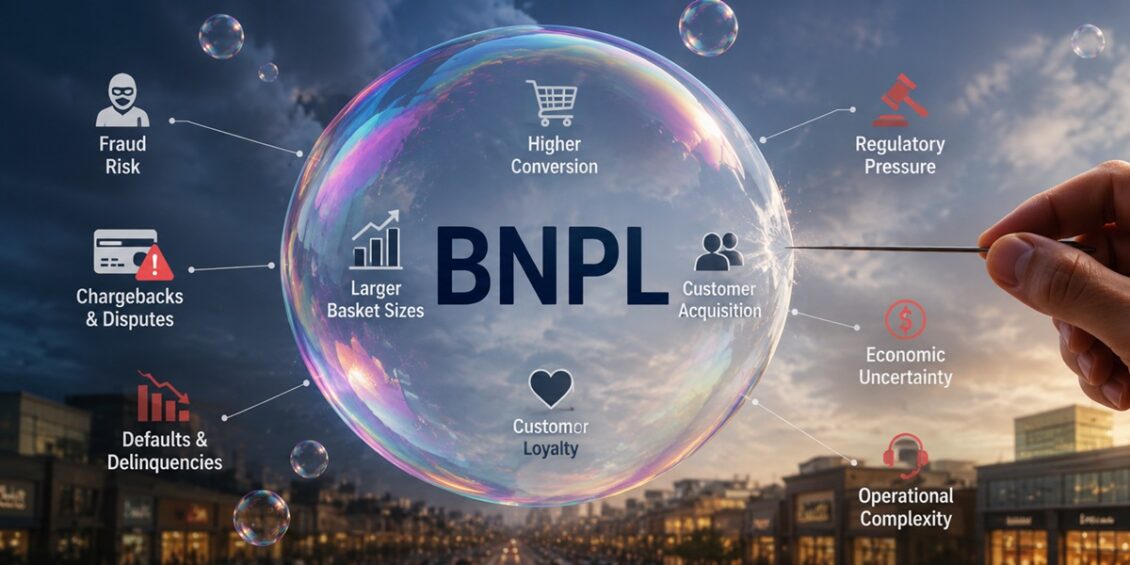
The “buy now, pay later” story has always had two versions running simultaneously.
In one version, installment payments are a conversion miracle: higher order values, new customers, reduced cart abandonment. In the other, they’re a dangerous liability, promising overleveraged consumers, regulatory exposure, and merchant fees that quietly erode margins that headline rates don’t reflect.
Both versions are true, at least to some extent. The merchants who’ve built sustainable BNPL strategies are those who’ve stopped choosing one story over the other and instead started managing both facets of BNPL at once.
The global BNPL market reached approximately $560 billion in gross merchandise value in 2025, representing a 13.7% year-over-year increase. That’s makes it easy to understand why so many merchants moved quickly to integrate BNPL at checkout. What it doesn’t tell you is how many of those merchants understood the full cost structure they were signing up for, or how exposed they’d be if the consumer credit picture deteriorated faster than projected.
I’ve spent enough time working with merchants across every major vertical to know that BNPL implementation decisions are often made at the marketing level, with the operational and financial implications considered later. That sequencing is exactly backwards.
Understanding the Real Cost Structure
The first thing merchants need to reconcile is the gap between what BNPL costs and what they expect it to cost.
BNPL results in an 85% higher average order value than other payment methods, and up to 40% of BNPL sales come from new customers to the retailer. These figures are real and they matter. But they need to be evaluated against the full cost picture, not just the headline rate and the conversion lift.
Merchant fees charged by BNPL providers typically run 5-8%, compared to 2-3% for credit card processors. That’s a meaningful premium, and the conversion lift that providers cite doesn’t automatically translate into net profitability when you factor in returns, disputes, and the operational complexity of managing multiple BNPL integrations.
Merchants who do that math carefully often find that BNPL is highly profitable for specific product categories and customer segments, and considerably less so for others.
Evaluating Providers in a Consolidating Market
Five companies currently dominate the US BNPL market: Klarna, Affirm, Afterpay, PayPal, and Sezzle, together accounting for over 95% of market share. That concentration creates a different kind of provider evaluation challenge than what existed three years ago, when the market was more fragmented and competitive. Today, most merchants are choosing between established players with distinct positioning rather than evaluating an open field.
What I’ve observed in conversations with merchants navigating this landscape is that provider selection often comes down to three practical questions:
- Which provider has penetration with your specific customer demographic?
- What are the actual settlement terms and how do they affect your cash flow?
- What happens when things go wrong?
That third question doesn’t get enough attention. In the event of returns, disputes, and customer service escalations, who is left holding the bag?
BNPL providers vary considerably in how they handle disputes and how much operational burden they pass back to the merchant. Returns processing and dispute handling still require tighter operational alignment across BNPL platforms. A provider that offers strong checkout conversion, but who creates chaos on the back end when a customer wants to return a split-pay purchase, isn’t serving your business as well as the conversion numbers suggest.
The Consumer Default Risk is Real
BNPL default rates remain relatively low at around 1.8-2%. But, approximately 34-41% of users report having missed at least one payment.
The gap between formal charge-off rates and self-reported delinquency is the most important number in the BNPL risk picture right now, and most merchants aren’t tracking it. A large population managing liquidity stress without yet tipping into default represents a systemic vulnerability that one macro shock could accelerate significantly.
Approximately 63% of borrowers hold multiple simultaneous BNPL loans. That figure tells us that these are not primarily consumers using installment payments as a convenience feature on purchases they could easily afford outright. Many are using BNPL as an active cash flow management tool across multiple simultaneous obligations.

After all, there wouldn’t be so many jokes and memes about financing a burrito from Chipotle if there wasn’t a degree of truth to it.
The uncomfortable truth is that, when one of those obligations goes sideways, the ripple effects touch every merchant in that consumer’s BNPL portfolio. Merchants offering BNPL have indirect exposure to the credit quality of their provider’s entire book of business, not just the purchases made at their checkout.
Understanding this isn’t a reason to avoid BNPL. Rather, it’s a reason to be selective about which providers you work with and how you structure your programs.
Managing Return Complexity
Returns are another dramatically underappreciated operational challenge in BNPL implementation.
Say a customer has made two of four installment payments, but then decides that she wants to return a product. This triggers a reconciliation process that involves your return policy, your BNPL provider’s rules, and the customer’s expectation of immediate resolution. Those three things rarely align cleanly.
The merchants who’ve managed this most effectively have built return policies that explicitly address BNPL scenarios. They’ve trained their customer service teams on provider-specific refund processes and set clear customer expectations at checkout about how returns work when installment payments are involved.
None of this is complicated. But, it requires intentional implementation, rather than just assuming the BNPL provider will handle the customer communication.
The Regulatory Dimension
The regulatory environment around BNPL is tightening in ways that will affect merchant operations, too.
The UK is implementing BNPL regulations in 2026. And, in the EU, member states were required to transpose the Consumer Credit Directive II into national law by end of 2025, with full enforcement expected to follow.
Meanwhile in the US, the Consumer Financial Protection Bureau’s federal classification attempt under Regulation Z was revoked in 2025. But, some states like New York have enacted their own BNPL regulations. This creates a fragmented regularly ecosystem; for the sake of compliance, though, it’s wise to always try to meet the standards of the most developed regulatory scheme.
What this regulatory evolution means practically for merchants is that the compliance landscape for BNPL will continue to vary by jurisdiction. The operational requirements for transparent BNPL disclosure at checkout will increase. Merchants who’ve invested in clear, consumer-friendly BNPL communication are better positioned for this transition than those who’ve treated disclosure as a checkbox rather than a customer experience consideration.
Building for Long-Term Sustainability
The merchants who will build durable BNPL programs share a common approach: they evaluate BNPL with the same financial discipline they apply to any other cost center.
They select providers based on operational partnership quality, rather than conversion promises alone. They also build internal processes that don’t assume the BNPL provider will handle customer issues on their behalf.
BNPL is a genuine value creator for merchants across many categories. BNPL can increase checkout conversion rates by 20-30%, making it a meaningful tool for reducing cart abandonment.
That value is real and worth capturing. The question is whether you’re capturing it profitably, with clear visibility into your full cost structure. Or, have you optimized for a conversion metric while absorbing costs and operational complexity that aren’t yet visible in your reporting?
The providers who built the BNPL market on the promise of frictionless credit are now navigating the maturation of that market alongside the merchants who adopted their products. Getting to the other side of that transition successfully requires merchants to take a more active role in how they structure, manage, and evaluate their BNPL programs. Passive BNPL isn’t a sustainable strategy anymore.
